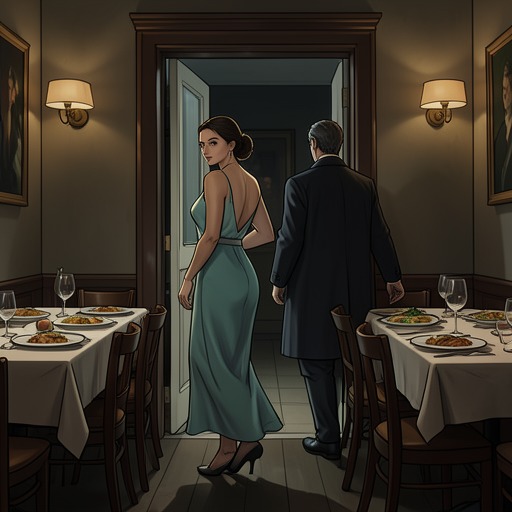
Courtney Lawrence
American PsychoCourtney Lawrence is a fashionable Manhattan socialite whose presence links several of the novel’s central relationships. She is introduced within an affluent domestic and social world of brownstones, designer clothing, expensive restaurants, champagne, and carefully managed appearances, yet her intimacy with Patrick Bateman unfolds inside a network of concealment and misrecognition. Her decisive significance lies in the contrast between the polish of her public identity and the emotional disorder surrounding her private life.
Identity and Introduction
Courtney first appears at the brownstone next to Evelyn Richards’s home, opening the door for Patrick Bateman and Timothy Price. She is dressed in a Krizia cream silk blouse, a Krizia rust tweed skirt, and silk-satin d'Orsay pumps by Manolo Blahnik. Her clothing establishes her as a participant in the same elite consumer culture that governs the men’s conversation and self-presentation. When Patrick and Timothy arrive, she takes their Giorgio Armani overcoats after air-kissing each man and greets them with a teasing complaint that they are late. The scene presents Courtney as socially fluent and confidently performative: hospitality, flirtation, brands, and manners all operate as parts of one polished ritual.
At Evelyn Richards’s gathering, Courtney helps organize the evening while also managing its romantic tensions. She leads Patrick toward the kitchen, explaining that Evelyn Richards has spent an hour rearranging sushi into initials. Evelyn Richards has considered spelling Patrick’s initials in yellowtail and tuna, but Courtney notes that she may instead use Timothy Price’s initials because there is not enough yellowtail to complete the design. Courtney asks Patrick whether he minds, sounding only slightly worried. The small exchange makes her an intermediary between competing attachments, and it also shows how intimacy is translated into a display made from expensive food and social choreography.
Relationships and Social Entanglements
Courtney is explicitly identified as Luis Carruthers’s girlfriend, but her behavior toward Patrick reveals a relationship that does not conform to the public arrangement. Patrick describes Courtney’s hands on his shoulders as she guides him toward the kitchen, and he responds by claiming jealousy and saying that he should speak with Evelyn Richards. The exchange is playful on the surface, but it places Courtney at the center of a triangle in which declared relationships and actual desire continually diverge. Her connection with Luis Carruthers is socially legible; her connection with Patrick is more secretive and unstable.
The novel repeatedly frames Courtney through the logic of possession, comparison, and status. At Barcadia, Patrick sits across from Evelyn Richards while waiting for the consequences of his conflicting arrangements: he has neither canceled the reservation at Turtles nor told Courtney not to meet him there. He expects Courtney to arrive confused and possibly furious, and he finds this prospect amusing. Courtney’s feelings are therefore treated by Patrick not as an ethical claim but as another element in a private scheme of timing, inconvenience, and emotional manipulation. The expensive clothes worn by both Patrick and Evelyn Richards, along with the Cristal that Evelyn Richards alters with cassis and blueberry syrup, make the scene’s material luxury inseparable from its relational dishonesty.
Courtney’s relationship with Luis Carruthers also becomes part of the novel’s broader confusion of identity. Patrick later encounters Luis Carruthers while holding a knife and threatening him before escaping by cab to Pooncakes. The encounter shows how quickly the social world’s controlled surfaces can give way to panic and violence. Courtney is not present in that scene, but her position as Luis Carruthers’s girlfriend gives the confrontation an additional relational charge: Patrick’s hidden involvement with Courtney exists within the same network that produces his hostility toward Luis Carruthers.
Intimacy and Emotional Disconnection
Courtney’s private intimacy with Patrick is shown without the language of mutual trust or sustained emotional recognition. In the episode set in Courtney’s bed, Luis Carruthers is in Atlanta while Courtney lies beside Patrick. She shivers, presses against him, and then relaxes, but Patrick cannot think of anything meaningful to say and produces the irrelevant remark, "Tiffany lamps… are making a comeback." His inability to respond to the immediate intimacy of the scene turns the bedroom into another setting for alienation rather than connection.
The details that follow intensify that disconnection. Patrick discovers a stuffed black cat with blue jewel eyes beneath him, remembers seeing it at F.A.O. Schwarz, and drops it onto the floor. Courtney opens a prescription bottle, shifts in bed, and later smokes while watching Late Night with David Letterman with the sound turned down. Patrick showers, dresses in a Ralph Lauren robe, and continues moving through the room as if intimacy were merely another scheduled environment. Courtney’s bodily presence is close, but the relationship remains emotionally remote; objects, clothing, television, and medication occupy the space where conversation or reassurance might otherwise occur.
This scene also places Courtney within the novel’s pattern of emotional states that are managed through commodities and routines. The stuffed cat, the prescription bottle, the expensive robe, and the muted television all coexist without producing genuine communication. Courtney’s apparent vulnerability is visible, but Patrick does not meet it with care. Instead, his attention shifts toward shopping, music, and the surfaces of domestic life. The result is not a stable romance but a portrait of intimacy emptied out by performance and avoidance.
Suspicion and Narrative Uncertainty
Courtney’s significance extends beyond her scenes because she belongs to the circle through which Patrick’s account of reality is tested. Paul Owen’s disappearance becomes the subject of an investigation by Donald Kimball, who has been hired by Meredith Powell. Kimball reports that Paul Owen left an answering-machine message saying he had gone to London, but Paul Owen’s girlfriend does not believe that explanation. Owen’s datebook, verified by his secretary, places him at dinner with Marcus Halberstam, and Kimball says that he has questioned Marcus Halberstam.
These investigative details undermine Patrick’s confidence that his private actions can remain contained within the social anonymity of Manhattan. Courtney is not the investigator and is not shown solving the mystery, but her relationship with Patrick exists within the same structure of concealed identities, mistaken names, and contradictory accounts. The world that allows her to move between Luis Carruthers and Patrick also allows Patrick to imagine that names, dates, and social encounters can be rearranged without consequence. Kimball’s evidence introduces a competing record of events, challenging the narrator’s control over what counts as reality.
Change and Narrative Role
Courtney does not receive a conventional arc of confession, escape, or romantic resolution in the supplied episodes. Instead, her position changes in the reader’s understanding. She begins as a composed hostess and recognizable member of an elite social scene, but her association with Patrick gradually reveals the fragility beneath that composure. She is linked to Luis Carruthers in public, drawn into Patrick’s secret sexual life, and placed amid conflicts that Patrick experiences as games until they become threats.
The most severe rupture comes when Patrick confesses to Harold Carnes that he killed Paul Owen, chopped off his head, tortured dozens of girls, and liked it. Harold Carnes does not accept the confession as a revelation. He replies that he had dinner with Paul Owen twice in London only ten days earlier, directly contradicting Patrick’s certainty. This reversal does not resolve Courtney’s situation; it deepens the uncertainty surrounding every relationship in which she participates. Patrick’s intimacy with Courtney is therefore neither a refuge from his unreliability nor proof of ordinary romantic feeling. It is another surface through which the novel examines identity’s interchangeability, the failure of social recognition, and the terrifying distance between what a person says, what others believe, and what may have happened.